Category: Uncategorized

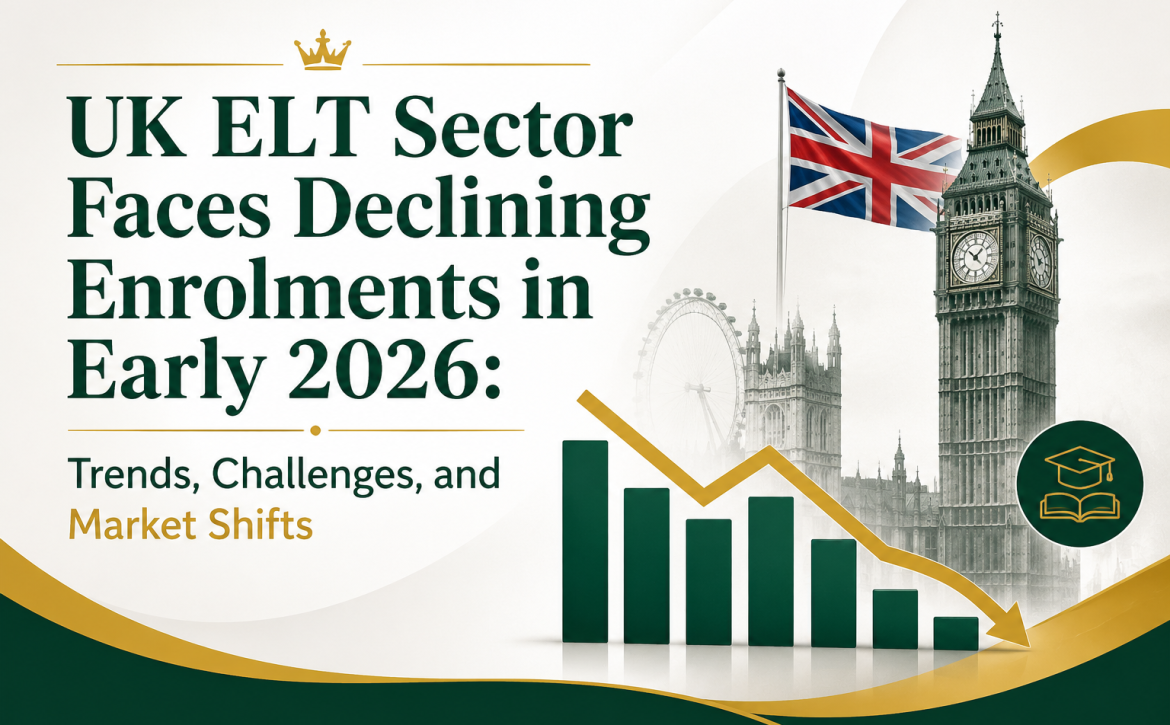
The Ultimate Guide to UK ELT Sector Declining Enrolments 2026: Trends, Challenges, and Future Outlook

Introduction

The UK ELT sector declining enrolments 2026 has emerged as one of the biggest concerns facing the English language education industry. For many years, the United Kingdom has been a preferred destination for international students seeking high-quality English language courses. However, recent data suggests that the sector is experiencing a significant slowdown, with fewer international learners enrolling and average course durations becoming shorter.

Although the UK remains a globally recognised hub for English language teaching (ELT), changing market conditions and increased international competition are reshaping the industry. Understanding the causes behind the UK ELT sector declining enrolments 2026 is essential for education providers, policymakers, and international recruitment agencies looking to secure the future of the sector.

Overview of the Current Market

The latest industry reports show that student numbers and total student weeks declined throughout 2025 and continued to fall in the early months of 2026. While some emerging markets have shown positive growth, these increases have not been enough to offset the drop in demand from several traditional source countries.

The UK ELT sector declining enrolments 2026 is not simply a matter of lower enrolment figures. Many students are now choosing shorter study programmes, reducing the total number of student weeks and limiting revenue opportunities for schools and local businesses that depend on international education.

Industry experts believe this trend reflects wider changes in the global education market, including economic uncertainty, changing travel preferences, and stronger competition from alternative English-speaking destinations.

ELT Sector Performance in 2025

According to English UK, which represents around 85% of accredited English language centres across the country, approximately 311,815 full-time students attended face-to-face courses during 2025. Together, these students generated around 998,045 student weeks.

Although these numbers represent a decline from previous years, the UK performed relatively better than some competing destinations, including Canada and Australia, where enrolment reductions were even greater. Nevertheless, the UK ELT sector declining enrolments 2026 highlights that the market is facing long-term structural challenges rather than a temporary downturn.

The private sector remains the main driver of the industry, with around 98% of ELT students enrolled at private language schools. Consequently, any reduction in international demand directly affects the financial stability of these institutions.

Impact on Private Language Schools

Private language providers have felt the impact of recent market changes more than any other part of the sector. In 2025, student numbers fell by 4.1%, while total student weeks dropped by 10%. At the same time, the average course duration declined from 3.3 weeks in 2024 to 3.1 weeks in 2025.

These figures clearly demonstrate the effect of the UK ELT sector declining enrolments 2026. Schools are facing a dual challenge: attracting fewer students while also managing a reduction in the average length of study. Shorter courses mean lower tuition income and reduced spending on accommodation, tourism, and other local services.

To remain competitive, many providers are exploring flexible course options, hybrid learning models, and stronger partnerships with international education agents.

Student demographics provide further insight into the changing market. Junior learners represented around 64% of total enrolments, reflecting the continued popularity of summer schools and short-term language programmes. However, adult learners contributed approximately 65% of all student weeks because they generally stay for longer periods.

This pattern is important when evaluating the UK ELT sector declining enrolments 2026. While junior enrolments remain relatively stable, a decline in adult learners has a greater impact on overall revenue and long-term market performance. Adult students often invest more in accommodation, local transport, and extended educational programmes, making them a vital segment for the industry.

Changing Global Demand

A major factor influencing the UK ELT sector declining enrolments 2026 is the shift in international demand. Some emerging markets are growing rapidly, while several long-established source countries are experiencing noticeable declines.

Growth Markets

Countries such as Türkiye and Argentina have delivered encouraging results despite the wider market slowdown. Türkiye recorded a 33% increase in student numbers and a 21% rise in total student weeks. Argentina also achieved strong growth, with enrolments increasing by 28.9% and student weeks by 24.5%.

These markets show that opportunities still exist for UK language providers willing to diversify recruitment strategies and invest in developing new international partnerships.

Declining Traditional Markets

In contrast, many traditional source markets have weakened considerably. Italy experienced a 7.6% decline in student weeks, while Saudi Arabia saw a 6.4% reduction. The most significant drop came from China, where student numbers fell by more than 33%, reducing its position among the UK’s top ELT source countries.

Across Asia, demand declined by around 26.2%, with Japan and South Korea also recording double-digit decreases. These trends further reinforce the seriousness of the UK ELT sector declining enrolments 2026, particularly because Asian countries have historically been major contributors to the UK language education market.

Industry Response and Future Strategies

Despite the challenges, sector leaders remain optimistic that the industry can recover through innovation and supportive government policies. English UK and other stakeholders believe that the market remains resilient and capable of adapting to changing global conditions.

Addressing the UK ELT sector declining enrolments 2026 will require collaboration between education providers and policymakers. Proposed solutions include expanding the Youth Experience Scheme, simplifying travel arrangements for school groups, strengthening international education partnerships, and improving alignment with the UK’s wider International Education Strategy.

At the same time, language schools are investing in technology, flexible learning pathways, and digital marketing to attract students from emerging regions and improve the overall learning experience.

Outlook for 2026 and Beyond

Early figures from the first quarter of 2026 suggest that the market remains under pressure. Total student weeks declined by around 7% compared with the same period in 2025, while adult student weeks fell by approximately 10%. Although junior student weeks recorded modest growth, this increase was not enough to offset the wider decline.

The UK ELT sector declining enrolments 2026 therefore remains a critical issue for institutions across the country. However, by focusing on market diversification, innovation, and strategic policy support, the sector can build a stronger and more sustainable future.

Conclusion

The UK ELT sector declining enrolments 2026 reflects a period of transition for the English language education industry. Falling enrolments, shorter study periods, and changing global demand patterns are creating challenges, but they also present opportunities for growth and innovation.

By targeting emerging markets, enhancing the student experience, investing in flexible course delivery, and working closely with government and industry partners, the UK can maintain its position as one of the world’s leading destinations for English language learning. Successfully responding to the challenges surrounding the UK ELT sector declining enrolments 2026 will be essential for ensuring the long-term strength and competitiveness of the sector.


Read More
kavya June 14, 2026 0 Comments

Master of Agriculture in Canada

Master of Agriculture in Canada for Nepali Students (2026): Universities, Fees, Requirements & PR Guide

M

  1. Introduction: Why Choose Canada in 2026?
  2. Why Study Agriculture in Canada?
  3. Why 2026 is the Best Time
  4. Top Universities in Canada
  5. Specializations Available
  6. Admission Requirements
    • Academic Requirements
    • English Language Requirements
    • Required Documents
  7. Application Process
  8. Cost of Studying and Living
    • Tuition Fees
    • Living Expenses
  9. Scholarships
  10. Career Opportunities
  11. PR Pathway
  12. Who Should Choose This Program?
  13. Conclusion

Introduction: Why Choose Canada in 2026?

If you’re a Nepali student with a background in agriculture, environmental science, biology, or food science, pursuing a Master of Agriculture in Canada for Nepali Students in 2026 can be a highly rewarding decision.

Canada is globally known for its advanced agricultural research, innovation, and high-quality education system. What makes 2026 particularly favorable is the recent policy change where Master’s programs are exempt from study permit caps. This makes a Nepali Students one of the safest academic pathways.

This guide will walk you through everything — from universities and fees to requirements, careers, and PR options for a Master of Agriculture in Canada for Nepali Students.


Why Study Agriculture in Canada?

Choosing a Master of Agriculture in Canada for Nepali Students offers strong academic and career advantages.

Some key benefits include:

  1. Globally recognized universities
  • High demand for agriculture professionals
  • Up to 3 years Post-Graduation Work Permit
  • PR opportunities after study
  • Affordable tuition fees
  • Spouse work permit options
  • Safe and welcoming environment

Why 2026 is the Best Time

2026 is a strategic year to pursue a Master of Agriculture in Canada for Nepali Students due to favorable immigration policies.

  • Master’s programs are not capped
  • Better visa approval chances
  • 3-year PGWP eligibility
  • Agriculture remains an in-demand field

Top Universities in Canada

Top universities offering a Master of Agriculture in Canada for Nepali Students include:

Tuition Fees

The cost of a Master of Agriculture in Canada for Nepali Students ranges from:

  • CAD 8,000 – CAD 35,000 per year

Most universities require IELTS 6.5 or above.


Specializations Available

A Master of Agriculture in Canada for Nepali Students offers multiple specializations:

  • Agribusiness
  • Crop Science
  • Animal Science
  • Agricultural Biotechnology
  • Food Safety
  • Environmental Agriculture
  • Soil Science

Admission Requirements

To apply for a Master of Agriculture in Canada for Nepali Students, you need:

Academic

  • Bachelor’s degree in relevant field
  • Minimum 70%–80%

English

  • IELTS 6.5+

Documents

  • SOP
  • LOR
  • CV
  • Transcripts
  • Research proposal

Application Process

Follow these steps for a Master of Agriculture in Canada for Nepali Students:

  1. Choose universities
  2. Prepare English test
  3. Collect documents
  4. Apply online
  5. Get offer letter
  6. Apply for visa
  7. Travel to Canada

Cost of Studying and Living

Tuition

  • CAD 4,800 – 35,000

Living Expenses

Students spend around CAD 1,200 – 2,200 monthly while pursuing a Master of Agriculture in Canada for Nepali Students.


Scholarships

Scholarships for a Master of Agriculture in Canada for Nepali Students include:

  • Canada Graduate Scholarships
  • Ontario Graduate Scholarship
  • University scholarships
  • Research assistantships

Career Opportunities

After completing a Master of Agriculture in Canada for Nepali Students, graduates can work as:

  • Agricultural Scientist
  • Agronomist
  • Food Technologist
  • Environmental Consultant
  • Farm Manager

Salary range: CAD 50,000 – CAD 95,000 per year


PR Pathway

A major benefit of a Master of Agriculture in Canada for Nepali Students is the PR pathway.

Options include:

  • Post-Graduation Work Permit
  • Express Entry
  • Provincial Nominee Programs

Who Should Choose This Program?

A Master of Agriculture in Canada for Nepali Students is ideal if you:

  • Have agriculture background
  • Want PR in Canada
  • Seek stable career
  • Plan long-term settlement

Conclusion

A Master of Agriculture in Canada for Nepali Students is a powerful combination of education, career growth, and immigration opportunity.

With strong demand, favorable visa rules, and PR pathways, choosing a Master of Agriculture in Canada for Nepali Students in 2026 is a smart decision for your future.

Read More
kavya June 9, 2026 0 Comments

Canada Updates Student Work Rules 2026: No Co-op Work Permit Required & Easier PGWP Process

Canada Updates Student Work Rules 2026

What are Canada Updates Student Work Rules 2026

Canada continues to strengthen its position as one of the top study destinations for international students. In 2026, Immigration, Refugees and Citizenship Canada (IRCC) introduced major updates to student work regulations—bringing significant relief and flexibility for students pursuing co-op programs, internships, and post-graduation work opportunities.

These new rules aim to simplify processes, reduce delays, and make it easier for international students to gain valuable work experience while studying in Canada.


Key Update: No Separate Co-op Work Permit Required (Effective April 1, 2026)

One of the most important changes is that international students no longer need a separate co-op work permit for work-integrated learning components.

What does this mean?

Previously, students enrolled in programs with mandatory work placements had to apply for:

  • A study permit, and
  • A separate co-op work permit

Now, as of April 1, 2026:
Only a study permit is required for:

  • Co-op placements
  • Internships
  • Practicums
  • Mentorship programs

Why this change matters

This update removes unnecessary administrative barriers and delays. Students can now:

  • Start their placements faster
  • Avoid application processing delays
  • Reduce stress and paperwork

According to immigration experts, this change will prevent students from missing valuable career opportunities due to permit delays.


Eligibility Criteria for Work-Integrated Learning (WIL)

To benefit from this new rule, students must meet all of the following conditions:

  • Must have a valid study permit
  • Study permit must include permission to work on campus
  • Must be a full-time student at a Designated Learning Institution (DLI)
  • Program must be:
    • At least 6 months long
    • At a post-secondary level
    • Leading to a degree, diploma, or certificate
  • Must have a letter from the DLI confirming that the work placement is mandatory
  • Work placement must not exceed 50% of the total study program

Important: This rule only applies if the work placement is a required part of the program.


Proposed Changes to Post-Graduation Work Permit (PGWP)

In addition to co-op changes, IRCC is also working on improving the Post-Graduation Work Permit (PGWP) system.

What is being proposed?

The government is considering allowing international students to work without a permit in the following situations:

  1. While waiting for a study permit extension decision
  2. While waiting for a PGWP application decision after graduation

Current Challenge for Students

Right now, many students face a gap between:

  • Completing their studies
  • Receiving their PGWP approval

This creates uncertainty about:

  • Whether they can legally work
  • Their employment status
  • Financial stability after graduation

How the New PGWP Proposal Helps

If implemented, the new rules would:

✅ Allow students to work legally during waiting periods
✅ Reduce employment gaps
✅ Improve financial security for graduates
✅ Provide a smoother transition from student to professional

Although timelines for implementation are not yet confirmed, these changes align with Canada’s broader goal of modernizing its immigration system.


Impact on International Students

Canada Updates Student Work Rules 2026, the country continues to offer a major advantage for students planning to study in Canada, especially those enrolling in programs with co-op or internship components.

Key Benefits:

With the Canada Updates Student Work Rules 2026, the country continues to offer:

  • Faster access to work opportunities
  • Reduced paperwork and processing time
  • Less risk of missing placements
  • More clarity in post-study work rights
  • Improved overall student experience

Why Canada Remains a Top Choice in 2026

With the Canada Updates Student Work Rules 2026, the country continues to offer:

  • High-quality education
  • Work-integrated learning opportunities
  • Post-study work options (PGWP)
  • Clear immigration pathways

These improvements under the Canada Updates Student Work Rules 2026 make Canada even more attractive for students from countries like Nepal, India, and other international markets.


Final Thoughts

The Canada Updates Student Work Rules 2026 introduced by IRCC mark a significant step toward simplifying student immigration processes in Canada. By removing the co-op work permit requirement and proposing flexible PGWP rules, the country is making it easier for international students to study, work, and build their future.

If you are planning to study in Canada, the Canada Updates Student Work Rules 2026 make this the perfect time to explore programs that include internships and co-op opportunities—now with fewer restrictions and faster access.

Read More
kavya June 4, 2026 0 Comments

Top 10 Reasons to Study in the USA

Top 10 reasons to study in the USA

The US is renowned for its world-class education system, diverse culture, and abundant opportunities for personal and professional growth. Here are the top 10 reasons to study in the US:

  • Top-Rated Universities
  • Various Cutting-Edge 
  • Research Opportunities for the Student Community
  • Prospects for Global Careers
  • Diverse Course Selections
  • Financial Assistance and Scholarships 
  • Diversity of Culture
  • Technological Innovation
  • Immersion in the English Language
  • Gorgeous Campuses in a Beautiful Setting

Student visa requirements for the US

The US Government offers three different student visa types:

 Types of student visaDescription
1F-1 Student Visato enroll in a US college or university that has been accredited, or to study English in an English language school
2J Exchange Visa (J-1)for taking part in an exchange program, such as studying at a university and in high school
3M Student Visa (M1)for non-academic or vocational study or training in the US

*For detailed information, please visit the US Government’s Department of State website.

Read more about USA Student Visa

Intakes available in the USA

American colleges and universities offer three intakes, as contrast to one in Indian universities. A semester is another term that some universities may use to describe admissions. In the US, there are three intake options:

  • Fall: A well-liked semester for students from Nepal, September is the start of the Fall intake.
  • Spring: January is the start of it; it’s advisable to skip the September intake.
  • Summer: Available for select universities and programs, the summer intake typically begins in May.

Learn more about intakes in the USA

IELTS for studying in the USA

Generally speaking, you must take the IELTS Academic exam and receive a score of at least 6.5 in order to apply for a US student visa. The minimal score may vary according on the kind of degree program. A score of 6.0 is normally required for undergraduate degrees, whereas a score of 6.5 is usually required for postgraduate studies. But bear in mind that certain universities can have different requirements for your score. A score of 7.0 or above is typically required by some elite universities, such as Ivy League colleges; other schools may only require 6.0 or 6.5.

Cost to study in the USA

Nepalese students’ overall cost of attendance in the US may differ depending on a number of variables, including the university, the area, the course, the living options, etc. Public/State and Private universities make up the two main groups of US universities. A public or state university will often cost less to educate students than a private one. The type of certification you choose and the institution or school you attend will determine how much you have to pay in tuition. You will require between $8,000 and $55,000 (USD) every year (indicative) to pay for tuition.

SchoolTuition fees in USD (indicative)
English language studies$700 to $2,000 a month
Community colleges$6,000 to $20,000 per year
Undergraduate
bachelor degree
$20,000 to $40,000 per year
Graduate programs$20,000 to $45,000 per year
Doctoral degree$28,000 to $55,000 per year


Read more about cost of studying in the USA

Scholarships to study in the USA

If you are wondering how to get a scholarship to study in the US, you can contact an KAVYA Global expert. They will help apply for eligible scholarships.

Nonetheless, each organization has a different cap on the total amount of money offered and the kind of reward. Some research programs will pay for all or part of your living expenses in addition to the tuition, up to 100% of it.

As a Nepalese student, you can apply to the following well-known scholarship programs to study in the United States:

S.No.Name of the scholarshipDescription
1Fulbright- Nehru Fellowships
(Government-funded)
Applicable for international students who are applying to master’s or PhD programs; this scholarship covers tuition fees, accident and sickness coverage as per US guidelines, airfare, and living costs
2Hubert Humphrey Fellowship Program
(Government-funded)
This program is a part of the Fullbright program and aims to bring an accomplished young and mid-career professional from a developing country to study in the US for 10 months of non-degree graduate study and related practical experience
3#YouAreWelcomeHere Scholarship (Non-Government scholarship)It’s a scholarship and social media campaign designed to welcome international students into the US higher education system irrespective of the subject area
4UEFA
(Non-Government scholarship)
This is a summer program sponsored by Abbey Road Inc. which grants scholarships to 14-18 aged high school student that shows exemplary performance in their academics and extracurricular activities
5AAUW International Fellowships
(Non-Government scholarship)
These fellowships are awarded to international women students for full-time study and research in the US. It supports both graduate and post-graduate students accredited in the US institutions
*This is an indicative list, speak with your KAVYA Global expert for details and the best available options suited to your profile
Please note: An MBA degree can cost significantly more, as can professional programs such as law, medicine, dentistry, some design programs, etc. Most doctoral degrees are 100% funded through research/teaching assistantships, research aid and bursaries
If you want to bring down your educational expenses, it is best to apply to various US scholarships available for Indian students.

Top courses to study in the US

If you are wondering about the best course to study in the US, here are the top fields preferred by international students:

  • Engineering and computer science courses
  • Life science courses
  • Business management courses

Job prospects in the USA

International students with talents are in demand due to a skills shortage in a variety of American industries. Those who are willing to settle in the country can apply for a Skilled Worker Visa, which allows them to work permanently in the nation. In the USA, there is a great demand for graduates, particularly in the fields of engineering, computer and information technology, healthcare, real estate, film production, and retail.

International students have the option to enroll in a variety of internship programs.

Read more here.

Cost of living in the USA

Living expenses differ significantly across the United States because of the country’s large territory. In general, metropolitan areas—those in or close to large cities—are more expensive than suburban or smaller towns. Therefore, when making your budget, keep in mind the following typical expenses to have a realistic idea of the overall cost of living in the US:

ExpensesAverage yearly cost*
Books and Stationery$500- $1,000
Traveling$500- $1,200
Food$2,500
Clothes and footwear$500
Miscellaneous expenses$2,000
*Note: All costs are indicative and may vary from region to region


FAQs (Frequently Asked Questions)

We have included answers to frequently asked questions students have regarding studying and living in the US because we know you have a lot on your mind.

Ques 1: What tests are required to study in the United States?

Answer: To be admitted to a US university, you must pass a number of tests, including the GMAT, GRE, SAT, ACT, and the English Language Proficiency Test (IELTS). Consult with

Ques 2: What are the popular fields in the US after the 12th Standard?

Answer: Here is a list of popular fields in the US after the 12th standard:

  • Business and Management
  • Engineering
  • Computer Science and Information Technology
  • Health Sciences
  • Social Sciences
  • Natural Sciences
  • Arts and Humanities
  • Education
  • Environmental Studies
  • Criminal Justice and Law

Ques 3: How much gap is accepted for study in the US?

Answer: Despite the fact that the US educational system is known for its strict rules, the majority of universities normally permit a one-year study break. However, in situations in which the gap is more than a year, students must offer a valid justification.

Ques: How much percentage is required to study in the US?

Ans: The percentage requirement varies with the university you are applying to. However, a score of 70% and above would be better for your admission to the US.

Check out more the FAQs for the USA

#studyinusafromnepal, #studyinusawithoutielts, #studyinusa #usastudentvisa, usavisaapplicants, #studyabroad #topreasontostudyinusa, #reasontostudyinusa

{Study in USA from Nepal, Study in USA Without IELTS, Study in USA, USA Student Visa, USA Visa Application, Study Abroad, Top Reason to Study in USA, Reason to study in USA}

Read More
kavya May 19, 2024 0 Comments